John Branksea Lockie
- conitext
- Nov 6
- 4 min read
Updated: Nov 7

John, born in 1909, was one of two sons, the other being his younger brother, Ralph, and they had two sisters, Molly and Grace. Molly went on to become a nurse and a career person, later marrying Sir Len Usher, and one of their children, Lala, has twice received and OBE from the Queen for her work with the Yellow-Eyed Penguins in New Zealand.
John’s parents, Bella and John Snr Lockie, also a naval engineer, had long lived at Northcote Point. In fact, John Snr’s father lived on Sulphur Beach when the sand was golden, decades before the Auckland Harbour Bridge was built.
Living on the point, John grew up with the sea. In his teen years he boarded at Mt Albert Grammar (see the picture of his brother Ralph in the school uniform). John Lockie joined the Navy, trained as an engineer, and when WWII broke out he was serving the Royal New Zealand Navy.
John was Mentioned in Dispatches in 1945 while a temporary Lieutenant R.N.Z.N.R for his bravery after he was able to successfully create a make-shift engine solution whilst under attack from the enemy. The engines having faulted, the crew were quite sure they were all going to die. John’s ability to focus under intense pressure whist show ingenuity was hence noted and awarded. Nevertheless, his ability to build, create, and work hard would continue to show after the war years in his following projects.
He worked as a ship surveyor and marine engineer for the North Island from 1946 for the next ten or so years. During this time, he also built the home my mother and sister, along with their mother, Amy, (my grandmother / nanny) would live in: 102A Queen St, Northcote Point. John had grown up next door in the house his parents owned, at 102, and the name ‘Branksea’ remains on the villa to this day.
John Branksea Lockie to be an Inspector of Machinery for the purposes of the Inspection
of Machinery Act, 1928, and a Surveyor of Ships for the purposes of the Shipping and Seamen Act, 1908, on and from the llth day of March, 1946.


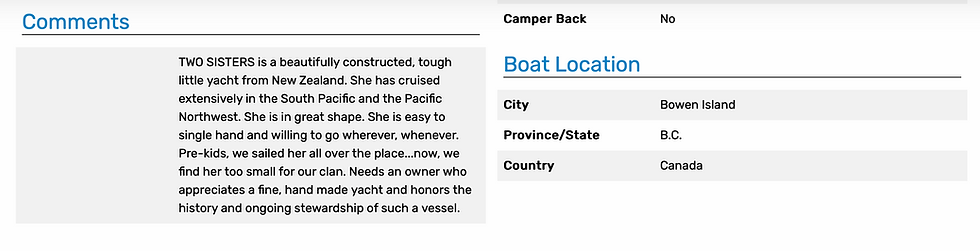
Around the early 1950s, when John was in his early 40s, he started to build his first boat, a 30ft (or 32ft? – is disputed) keeler, what would be named, Two Sisters. Of course, the obvious reason for the name being his two daughters, Pamela and Jacquline, but also, I’ve since discovered a book was published in 1924 called the Voyages of the Two Sisters: A Cabin Boy’s Story, by Egbert Bull Smith. It makes me wonder, as John would’ve been about 15 at the time this book was published, if he didn’t read it!
My grandmother, or Nanny, as I called her, wanted standing head room in the yacht. There were, no doubt, luxuries John considered for her. Later, as it become apparent Nanny didn’t like sailing so much, John built a launch, Lady Selina, named after Amy’s middle name. This second boat however, built in the late 1960s, was a smaller build, in that the hull had already been assembled and John ‘simply’ built the cabin.
John was always working on the Two Sisters, to the point it brased off Nanny somewhat. Sounds like every wife’s annoyance – who is married to a boatie – mind you there are a lot of women out there who are just as passionate about the water.

Next post I’ll share what my mum and aunt recall about their sailing times.
John was masterful, not only in his proven skill, but his ability to dream. It takes a dreamer to build a boat – two, and a house! You have to believe in possibilities, and be hard working.
One of his favourite poems was, ‘If’ by Rudyard Kipling. Also, John used to often say, ‘love many, trust few, and paddle your own canoe.’ He would whistle too. Walk about whistling. I remember him. I was in my fifth year when he died. I remember his death. He was only 64 when he died. Mum says his last words were, ‘I’m home.’ He must’ve been on a marvellous boat!
He was like the sun to me. The love I felt from him as a small child felt like the sun. We lived just across the road, and once John was sick, after he’d let go of the boats, and the café business he’d opened in Newmarket called, Giovani House, which my grandmother was left managing for a time before it was sold after he died, he would come and sit on the steps of our house in the sun, spending this time with us. I remember his work ‘shed.’ A lot of Grandpa’s tools were sold after he died, although one or two are still floating around in the family.
What a legacy he left – such a quiet one – that yields all these years later. I must note though, he never took part in the war parades – ANZAC Day as it’s known in New Zealand, when the returned service men would / still do march. I remember them all with their medals and uniforms. The bagpipes and drums – it was quite eventful. Mum said he was not a fan of such matters. He never spoke about the war. Even the fact he was Mentioned in Dispatches wasn’t something one ever knew readily, despite the fact he had quite a few medals.
Grandpa’s legacy is diverse. For a short life, just 64 years, he really achieved such a great deal.

Comments